Curve Sketching
Functions of the general form y=ax+q are called hyperbolic functions.
y=h(x)=1x
You just need to substitute the values into the equation.
h(14)h(12)h(1)h(2)h(3)=====114112111213=====4211213
From the table we get the following points: (−3;−13) , (−2;−12) , (−1;−1) , (−12;−2) , (−14;−4) , (14;4) , (12;2) , (1;1) , (2;12) , (3;13) .


Functions of the form y=mx+c

The effect of m
As m increases, the gradient of the graph increases.
If m>0 then the graph increases from left to right (slopes upwards).
If m<0 then the graph increases from right to left (slopes downwards).
For this reason, m is referred to as the gradient of a straight-line graph.
The effect of c
We also notice that the value of c affects where the graph cuts the y -axis. For this reason, c is known as the y -intercept.
If c>0 the graph shifts vertically upwards.
If c<0 , the graph shifts vertically downwards.
Gradient and y -intercept method
We can draw a straight line graph of the form y=mx+c using the gradient m and the y -intercept c .The gradient of a line is the measure of steepness. Steepness is determined by the ratio of vertical change to horizontal change:
For example, y=32x−1 , therefore m>0 and the graph slopes upwards.

Increasing and decreasing functions
The derivative of a function can tell us where the function is increasing and where it is decreasing. If
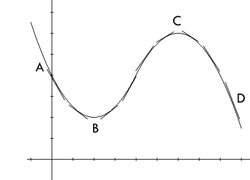
a) f'(x) > 0 on an interval I, the function is increasing on I.
b) f'(x) < 0 on an interval I, the function is decreasing on I.
b) f'(x) < 0 on an interval I, the function is decreasing on I.
The intervals of increase and decrease will occur between points where f'(x)
= 0 or f'(x) is undefined.
From A to B, the slope of the tangent lines are all negative, so the derivative, f'(x) is negative from A to B. The theorem above states that the function is decreasing from A to B. Similarly, the function is also decreasing between C and D. From B to C however, the slopes of the tangent lines are positive.
If:
a) f' changes from positive to negative at c, there is a local maximum at c.
b) f' changes from negative to positive at c, there is a local minimum at c.
c) f' does not change sign at c, there is no maximum or minimum at c.
b) f' changes from negative to positive at c, there is a local minimum at c.
c) f' does not change sign at c, there is no maximum or minimum at c.


No comments:
Post a Comment