Statistics and probability
Chapter 15 & 16
Collecting data
Group the data into the following ranges and draw a histogram of the grouped data:
130140150160170≤h<140≤h<150≤h<160≤h<170≤h<180
Answer:
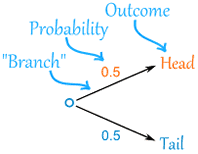
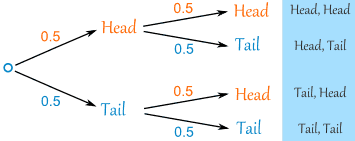
The probability is on the branch and the outcome is at the end of the branch.
Collecting data
When there are too many numbers reaching to thousands, we are not able to manage them well so we do collecting data. By applying statistics properly we can highlight the important aspects of data and make the data easier to interpret.
Quantitative data
Data that can be written as numbers
Qualitative data
Data can't be written as numbers
Grouping data
Subdividing the full range of values into a few sub-ranges. By assigning each continuous value to the sub-range or class within which it falls, the data set changes from continuous to discrete.
Example :Groups and histograms
The heights in centimetres of 30 learners are given below.
142
|
163
|
169
|
132
|
139
|
140
|
152
|
168
|
139
|
150
|
161
|
132
|
162
|
172
|
146
|
152
|
150
|
132
|
157
|
133
|
141
|
170
|
156
|
155
|
169
|
138
|
142
|
160
|
164
|
168
|
Group the data into the following ranges and draw a histogram of the grouped data:
Answer:
56
|
49
|
40
|
11
|
33
|
33
|
37
|
29
|
30
|
59
|
21
|
16
|
38
|
44
|
38
|
52
|
22
|
24
|
30
|
34
|
42
|
15
|
48
|
33
|
51
|
44
|
33
|
17
|
19
|
44
|
47
|
23
|
27
|
47
|
13
|
25
|
53
|
57
|
28
|
23
|
36
|
35
|
40
|
23
|
45
|
39
|
32
|
58
|
22
|
40
|
Probability
P(E) = The number of ways that event can occur n(E)
The number of elements in the sample space n(S)
P(E) = n(E)
n(S)
Probability is always between 0 and 1
The number of elements in the sample space n(S)
P(E) = n(E)
n(S)
Probability is always between 0 and 1
The probability is on the branch and the outcome is at the end of the branch.
CONSECUTIVE EVENTS
Consecutive events are those events which occur one after another, we can find the probability of these types of events by multiplying the probability of one consecutive event with other.
Example
A die is rolled into the surface and a coin is tossed up in the air and a card is drawn from a pack of 52 cards consecutively. So find consecutive probability of getting 5 on die, head on coin and ace on card.
Solution: firstly we will find the Probabilities separately then we will combine them,
Probability of getting 5 = 5/6,
Probability of getting a head = 1/2
Probability of getting a ace = 4/52=1/13
Result: = 5/6*1/2*1/13
= 5/156
INDEPENDENT EVENTS
Two events, A and B, are independent if the fact that A occurs does not affect the probability of B occurring.
Example:
A card is chosen at random from a standard deck of 52 playing cards. Without replacing it, a second card is chosen. What is the probability that the first card chosen is a queen and the second card chosen is a jack?
Answer:
The probability that the first card is a queen is 4 out of 52. However, if the first card is not replaced, then the second card is chosen from only 51 cards. Accordingly, the probability that the second card is a jack given that the first card is a queen is 4 out of 51.
Consecutive events are those events which occur one after another, we can find the probability of these types of events by multiplying the probability of one consecutive event with other.
Example
A die is rolled into the surface and a coin is tossed up in the air and a card is drawn from a pack of 52 cards consecutively. So find consecutive probability of getting 5 on die, head on coin and ace on card.
Solution: firstly we will find the Probabilities separately then we will combine them,
Probability of getting 5 = 5/6,
Probability of getting a head = 1/2
Probability of getting a ace = 4/52=1/13
Result: = 5/6*1/2*1/13
= 5/156
INDEPENDENT EVENTS
Two events, A and B, are independent if the fact that A occurs does not affect the probability of B occurring.
Examples:
- Landing on heads after tossing a coin AND rolling a 5 on a single 6-sided die.
- Choosing a marble from a jar AND landing on heads after tossing a coin.
- Choosing a 3 from a deck of cards, replacing it, AND then choosing an ace as the second card.
DEPENDENT EVENTS
Two events are dependent if the outcome or occurrence of the first affects the outcome or occurrence of the second so that the probability is changed.Example:
A card is chosen at random from a standard deck of 52 playing cards. Without replacing it, a second card is chosen. What is the probability that the first card chosen is a queen and the second card chosen is a jack?
Answer:
The probability that the first card is a queen is 4 out of 52. However, if the first card is not replaced, then the second card is chosen from only 51 cards. Accordingly, the probability that the second card is a jack given that the first card is a queen is 4 out of 51.

No comments:
Post a Comment