Further trigonometry
Chapter 12
 In the right-angled triangle, the side opposite to the right-angle is labelled the hypotenuse, the side opposite θ is labelled “opposite”, the side next to θ is labelled “adjacent”.
sinθcosθtanθ===oppositehypotenuseadjacenthypotenuseoppositeadjacent

Trigonometry is a branch of mathematics that studies relationships involving lengths and angles of triangles.
 In the right-angled triangle, the side opposite to the right-angle is labelled the hypotenuse, the side opposite θ is labelled “opposite”, the side next to θ is labelled “adjacent”.
Define the trigonometric ratios, sine, cosine and tangent of an angle, as follows:
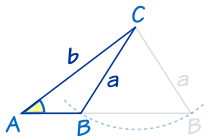
The sine rule
- two sides and an angle opposite to one of the two sides
- one side and any two angles
Example
Find the size of angle R.

Substituting in: 
Cross multiplying: 
Dividing by 9: 
Taking inverse sine: 
The cosine rule
| If you need to find the length of a side, you need to know the other two sides and the opposite angle. You need to use the version of the Cosine Rule where a2 is the subject of the formula:
Example |
 | |||||||||||||
| Step 1 | Cosine Rule formula for finding sides:
| ||||||||||||
| Step 2 | Fill in the values you know, and the unknown length:
| ||||||||||||
| Step 3 | Evaluate the right-hand-side and then square-root to find the length:
| ||||||||||||

No comments:
Post a Comment